.png)
.png)
Artificial Intelligence
AI won't fix your content chaos. It amplifies it.
AI is a multiplier, not a mop. Why structure, not a better model, is what makes AI pay.

You bought the AI licences. Output went up. So why can't your team find the right asset, and why is there still no ROI? Here's the uncomfortable truth. AI is a multiplier, not a mop. It scales whatever you feed it. Feed it chaos, and you get faster chaos.
A marketing leader told me recently that she'd rolled out AI across her content team. Six months on, output had tripled. Approvals hadn't. Findability was worse. Her CFO wanted to know where the return was.
She didn't have an AI problem. She had a structural problem, and AI had made it louder.
Here's what I've learned across 20 years of watching transformation projects succeed and fail. AI doesn't fix a broken content operation. It amplifies it. Point it at clean, connected content and it compounds value. Point it at scattered, contradictory content and it manufactures mess at machine speed.
The fix sits one layer down, in the content itself.
Key takeaways
• AI is a multiplier, not a mop. It scales whatever you feed it, order or chaos.
• The problem isn't messy metadata, it's missing metadata. AI can't apply rules nobody wrote down, so it fills the gaps with confident guesses.
• Speed without AI content governance is faster risk: unapproved claims, expired rights, off-brand output at volume.
• Structure first is what makes AI pay. A European online retailer with roughly €11 billion in revenue and 20 million assets saw 168% ROI and €2.6M in net value once its content was connected (Forrester, 2025).
• Run the AI Amplifier Test before you scale: score Findability, Connection, and Trust. Fix the weakest first.
The silver bullet is the most expensive mistake
Most enterprises treat AI as a bolt-on. Buy the licences, switch on the features, wait for the mess to sort itself out. It doesn't work, because AI has no opinion about your content. It inherits the structure you already have and runs it faster.
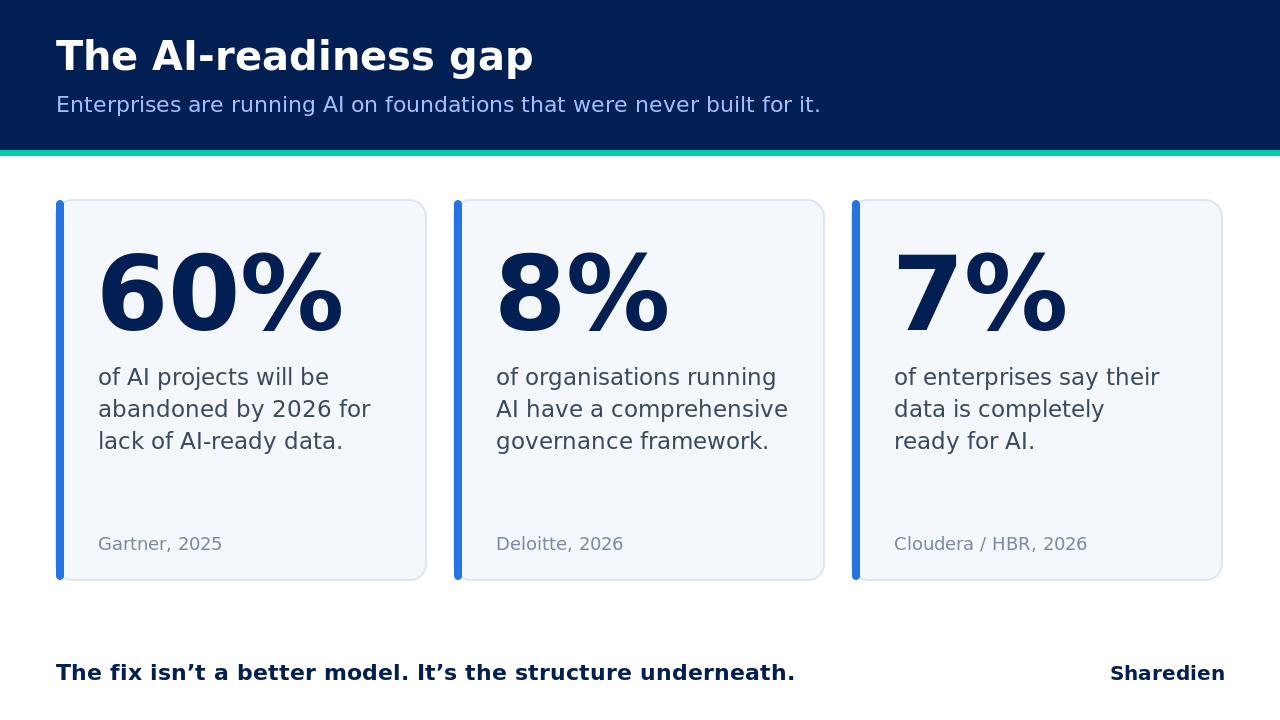
According to the Content Marketing Institute, as much as 30% of customer-facing content now comes from some form of AI assistance, and less than half of it passes any formal review. That isn't efficiency. That's unreviewed content shipping at scale.
The tooling arrived. The foundation didn't. Only 8% of organisations that have deployed AI maintain a comprehensive governance framework for it (Deloitte, State of AI in the Enterprise 2026, surveying 3,235 IT and business leaders). Almost everyone is running AI. Almost nobody has decided what it's allowed to do.
I've seen this film before. The questions we're asking about AI are the questions we asked when digital transformation projects were failing a decade ago. No clear mission. Messy data. Teams working in silos. The technology was never the problem. The foundation was.
So what does amplified chaos look like inside a company? Three patterns, and I see all three inside the same organisation more often than you'd think. Pilots run too loosely coupled across the business, so they never connect and never harvest the value. Three departments quietly build the same use case, three different ways. And the models amplify whatever bad data they're handed.
Most enterprises are data rich and insight poor. They have the assets. They have the data. They can't turn either into decisions, and pouring AI on top of that gap doesn't close it. It widens it.
The real cost lands later, when a CFO stops funding the next one.
AI is a multiplier, not a mop
AI is a multiplier, not a mop. It scales whatever you feed it, and the input decides the outcome. Feed a model clean, connected, rights-cleared content and it enriches, finds, and reuses faster than any team could. Feed it a scattered library with inconsistent metadata, and it amplifies the inconsistency at machine speed.
AI is a multiplier. It scales whatever you feed it. The input decides the outcome.
Large language models are exceptional at one thing in particular: amplifying the pattern they're given, including the wrong one. Which is why "we bought AI and it just amplified the chaos" has become one of the most common sentences I hear from enterprise marketing leaders.
This isn't a fringe problem. Only 7% of enterprises say their data is completely ready for AI (Cloudera and Harvard Business Review Analytic Services, 2026).
The way out is to give AI a better foundation to work from. We call that foundation the Content Value Chain.
The Content Value Chain is the path every asset travels from creation to reuse: connected to product data, business context, and the people accountable for it, then enriched, governed, and made findable for humans and machines.
A traditional digital asset manager stores files. It's a filing cabinet with search. The Content Value Chain does something different. It connects your assets to the data around them, the product record, the campaign, the rights, the market, and the people responsible for each, so every asset carries context rather than just pixels.
Asset plus data plus product plus people. Drop any one of the four and the chain breaks. Most organisations remember the first three and forget the fourth, which is why so many well-structured systems still stall. Nobody owns the decision about what's allowed.
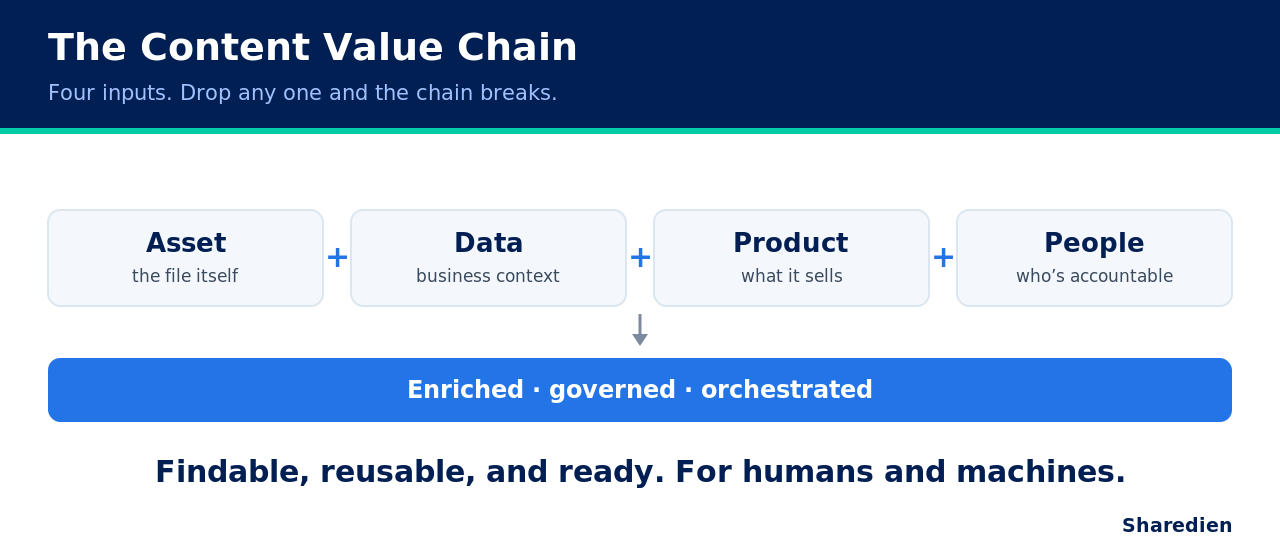
Put it simply: your content is only as smart as the structure underneath it.
That context is exactly what AI needs to be useful. A model can't reason about an asset it can't understand. Give it "a photo," and you get generic output. Give it "the approved hero image for this product, in this market, cleared until December," and AI has something real to act on.
Structure is what turns AI from a liability into an advantage. Without it, you aren't running an AI pilot. You're running an expensive automation exercise that amplifies your worst data.
The problem isn't messy metadata. It's missing metadata.
Point AI at a library with thin descriptions and it can't rescue you. It fills the gaps with confident guesses, at machine speed. The failure most enterprises assume is inconsistency, teams describing assets differently. The real failure is absence. The descriptions and the rules were never written down.
Here's the part people get wrong. Different teams describing the same asset differently isn't the problem. Marketing needs a campaign view, product needs a SKU view, and a good data model holds both at once. Multiple perspectives on one asset are a strength, as long as they're mapped to each other.
The problem is what's missing. Most assets never carry the descriptions that would make them usable in the first place: which brand, which market, which product it belongs to, what rights apply, when they expire, what's approved and what isn't. Only 11% of organisations have high metadata management maturity (DATAVERSITY, 2025 Trends in Data Management).
Then there are the rules nobody wrote down. How many brands do you actually run? What's allowed in which market? What can never appear alongside what? When those answers live in people's heads instead of in your data model, AI cannot infer them. It will do exactly what it's told, confidently, at scale.
This is why the foundation decides the outcome. Gartner expects organisations to abandon 60% of AI projects through 2026 for lack of AI-ready data foundations.
Metadata is context. Thin descriptions and undocumented rules mean every downstream AI decision inherits the gap. My advice to customers never changes: get your metadata in order first.
Scale makes this worse. At 20 million assets, a 2% gap in your descriptions leaves hundreds of thousands of files that your team, and your AI, will trip over for years.
Clean structure first. Then let AI enrich. In that order, Smart Tagging becomes an accelerant. Reverse it, and the same feature becomes a liability you pay for every day.
Speed without AI content governance is just faster risk
AI doesn't only misfile content. It ships content faster than anyone can check it, which turns a speed advantage into a compliance exposure. AI content governance is what closes that gap: the rights, approvals, and quality controls that let output scale without putting the brand at risk.
AI content governance is the set of rules, thresholds, and approvals that decide what AI-generated content is allowed to ship, and who signs off.
Call it the content paradox. Generative AI can spin up 150 variants of an asset in a day, but volume isn't value. My own marketing team has more trouble approving content than creating it. Point AI at that bottleneck and it widens, fast.
When output triples and review capacity stays flat, the gap fills with unreviewed material. An AI-generated product description that overstates a claim isn't only off-brand. In regulated sectors like healthcare, finance, or consumer goods, it can be illegal. Expired image rights, outdated logos, unapproved claims: all of them scale with your output unless governance scales with it too.
Large language models amplify bias and wrong data as readily as good data. The less accurate your source, the faster chaos spreads. Speed is the feature that makes AI valuable and the feature that makes it dangerous, at the same time.
The risk isn't hypothetical. On grounded summarisation tasks, many leading reasoning models still hallucinate more than 10% of the time, and even the best sit around 3% (Vectara Hallucination Leaderboard, 2026). Now run that error rate across thousands of auto-generated assets. And the guardrails aren't keeping pace: only 21% of organisations say they have a mature governance model for agentic AI (Deloitte, 2026).
This is where governance earns its keep. Done properly it speeds you up, because the rules are what let you move fast safely. Rights, approvals, and brand rules built into the flow mean AI can generate at volume while every asset that ships is cleared, current, and on-brand. Governance made easy is what makes speed survivable.
The enterprises getting this right don't slow AI down. They give it guardrails, so the volume works for them instead of against them. The mechanics are unglamorous, and they work: confidence thresholds that flag low-certainty tags for a human, approval workflows that catch the claim that shouldn't ship. AI Quality Check and governed approvals are what stop a fast content engine from becoming a fast liability engine.
The question isn't "how much can we produce?" It's "how much can we produce that we'd actually stand behind?" Without governance, those two numbers drift apart. With it, they move together.
Structure first is what makes AI pay
Get the foundation right and the economics change. This is the part a CFO can act on: when content is connected to the data around it before AI scales across it, the returns show up in months rather than years. The independent numbers make that case better than any argument I could offer.
Consider a European online retailer with roughly €11 billion in annual revenue and 20 million digital assets. It connected its content to its product and campaign data before scaling AI across its operation. The result, measured independently by Forrester: 168% return on investment, €2.6 million in net present value over three years, €4.2 million in total benefits, and a 14-month payback (Forrester Total Economic Impact study, 2025).
That return didn't come from a smarter model. It came from structure. Once assets were connected and enriched against clean data, AI had something worth acting on, and the value compounded.
Or take a €1-billion European industrial manufacturer operating across 48 markets. It connected its data sources, its ERP and product lifecycle systems, into a single content hub. Now when a product spec changes on the production line, the update flows to all 48 sales channels in close to real time. Nothing magical is happening here. The AI is acting on connected, trustworthy data, so it moves at a speed manual work never could.
To be fair, a platform like ours isn't the whole story. Strong data lakes and customer data platforms can build these connections too. The point was never the tool. It's the discipline. Get the structure right, and any capable AI has something worth acting on.
The pattern is always the same. Structure first, then scale. The companies furthest ahead with AI aren't the ones with the best models. Everyone has access to the same models now. They're the ones that got their data in order first.
That's the good news hiding inside the bad. The amplifier works both ways. The same force that multiplies chaos multiplies value, once the foundation is there.
What this doesn't mean
This isn't an argument against AI. Far from it. We run AI across our own company, and we build an open AI architecture so customers can bring their own model. The technology is extraordinary. The mistake is pointing it at a broken foundation and expecting it to compensate for what was never fixed.
It also doesn't mean "wait until your data is perfect." It never will be. It means sequence the work: get the foundation good enough to build on, then let AI scale it. Structure first doesn't mean structure forever before you start.
And it doesn't mean AI runs itself. The industry talks constantly about keeping a "human in the loop." True, but not enough. You need a human in the lead and a human in the loop. In the lead, setting the strategy and the standard. In the loop, approving what ships. AI has no compound interest yet: someone still needs the judgement to decide what's good. The teams winning with AI treat it as an accelerant for human judgement, not a replacement for it.
The AI Amplifier Test
Before you scale AI across your content, run one diagnostic. I call it the AI Amplifier Test, because AI will multiply whatever it touches. The test scores the three things it will multiply. Fix the weakest before you scale, not after.
1. Findability. Can a person and a machine find the right asset in seconds? This starts with metadata, because metadata is context. The real test is whether the descriptions exist at all, and whether the rules are written down: which brand, which market, what's approved, what's expired. If those answers aren't in the data model, AI can't apply them. At 20 million assets, a 2% gap means hundreds of thousands of files your team and your AI will trip over for years. Score your metadata honestly. If it's thin, that's your first fix, before AI touches anything.
2. Connection. Are your assets connected to the data around them: the product record, the campaign, the market, the rights? An isolated asset is a dead end for AI. The €1-billion manufacturer above joined its ERP and product lifecycle systems to its content hub, and a spec change now reaches 48 sales channels in close to real time. That is what connection buys you. Connection is what turns a file into an answer.
3. Trust and alignment. Are rights, approvals, and brand rules built into the flow, and are the right people aligned behind it? This is the people half of the chain, and it's the half most often skipped: only 8% of organisations running AI have a comprehensive governance framework for it (Deloitte, 2026). Alignment keeps the work coordinated, so marketing, product, IT, and service aren't building five versions of the same thing. AI amplifies misalignment as fast as it amplifies bad data.
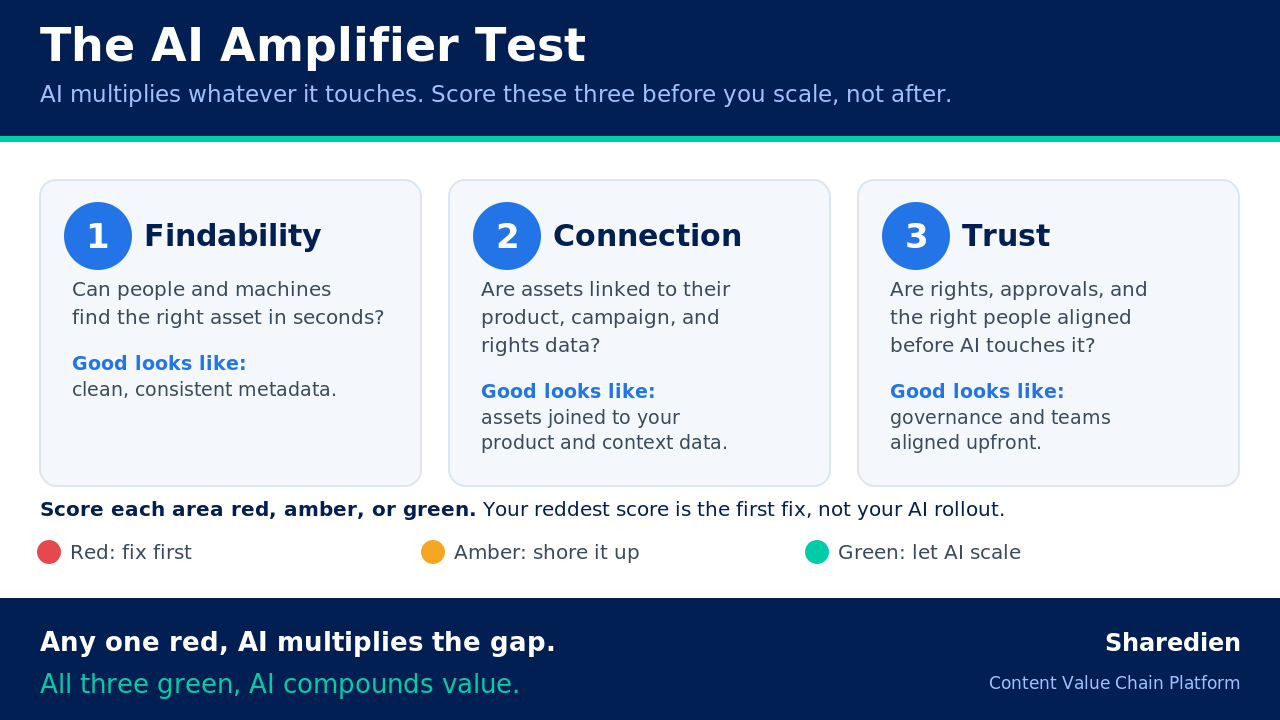
Here's how the three work together. Findability makes assets usable. Connection makes them intelligent. Trust makes them safe to scale. Miss one and AI multiplies the gap. Get all three and AI compounds the value, cycle after cycle. That's the Content Value Chain in practice: findable, reusable, and ready.
The test also tells you where to start. Score each area red, amber, or green. Your reddest score is your first project, not your AI rollout. Most enterprises discover their weakest link is Connection. They have assets and they have data, but the two have never been joined. That's not a model problem. No amount of AI fixes it. It's a structure problem, and structure is fixable.
Run the test before the pilot, and you stop paying for chaos amplified. Run it and act on it, and the next AI project you fund is the one that finally shows a return. Good stewardship, in other words: get your house in order, tell everyone why, then let AI do what it's actually good at.
FAQ
Will AI fix our messy content library?
No. AI scales whatever it's given. If the descriptions are thin and the rules were never written down, AI fills the gaps with confident guesses and generates more unstructured content, faster. It amplifies the gap rather than closing it. Describe and connect your assets first, then AI enrichment becomes an accelerant instead of a liability.
What is AI content governance?
AI content governance is the set of rules, thresholds, and approvals that decide what AI-generated content can ship, and who signs off. In practice it means confidence thresholds that flag low-certainty tags for a human, rights and expiry checks, and approval workflows that catch an unapproved claim before it reaches a customer. It is what lets output scale safely.
Isn't modern AI tagging good enough now?
AI tagging is powerful, but it's only as good as the structure beneath it. A generic model can label "a meeting" but can't tell an executive briefing from a board review without your context. It also can't know which brand, market, or rights apply unless you've documented them. Give it that context and the same tagging becomes reliably useful.
What's the difference between a DAM and a Content Value Chain?
A traditional DAM stores and searches files, like a filing cabinet. A Content Value Chain connects those assets to the data around them (product records, campaigns, rights, and markets), then enriches, governs, and distributes them. The difference is context: a Content Value Chain gives every asset the meaning that both humans and AI need to use it well. The same logic separates a DAM from a PIM.
Where do we start if our metadata is a mess?
Start with metadata, because metadata is context. Audit how assets are tagged today and where teams disagree. Agree one shared structure, then connect assets to your product and campaign data. Align the people who own those systems: marketing, product, and IT. Only then scale AI. The AI Amplifier Test gives you a simple way to score readiness and pick the first fix.
Turn the multiplier in your favour
AI is the most powerful multiplier your content operation has ever had, and that is exactly why it's dangerous. It scales what's already there. For most enterprises, what's already there is scattered, inconsistent, and hard to trust, which means the first thing AI multiplies is the mess.
So the question isn't whether to adopt AI. It's what you point it at. Point it at chaos and you get faster chaos. Point it at a connected, governed Content Value Chain and you get compounding value, the kind a CFO can measure.
Tomorrow, do one thing: run the AI Amplifier Test on your own operation. Score Findability, Connection, and Trust. Your reddest score is where you start, and it's almost certainly not your model.
Before you scale AI across your content, see what governed AI actually looks like. Our ebook on AI tagging shows how confidence thresholds and review workflows turn automation into an asset you can trust, instead of a liability you pay for every day.
About the author
As Co-CEO of GTM at Sharedien, Simon shares his experiences and insights on this blog regarding go-to-market strategies, digital growth, content operations, AI and the future of modern enterprise technologies. LinkedIn

More
articles
Keep reading and take a look at our latest blog articles.
.jpeg)
.jpeg)
Driving your Content Value Chain



Sharedien is part of the ECC Cologne community


Sharedien & ThoughtSpark