

Digital Asset Management
Improving Data Quality: The Foundation for AI Readiness and a High-Performing Content Value Chain
How companies can reliably connect assets, metadata and product context, make data quality measurable and scale AI-powered content processes.

Today, digital content is far more than images, videos or documents. Together with metadata, product information, usage rights and process data, it forms the operational foundation of an end-to-end content value chain. Only when this information is reliably maintained and intelligently connected can companies efficiently create, enrich, distribute and reuse content.
Poor data quality, by contrast, manifests itself in very tangible ways: teams cannot find assets, produce duplicate content, use outdated versions or have to carry out manual rework before every product launch. As the use of AI increases, requirements are rising further. Semantic search, automated classification, content generation and intelligent workflows require not only the data itself, but also reliable context. Data quality is therefore evolving from an operational maintenance issue into a strategic prerequisite for AI readiness.
What Does Data Quality Mean in the Content Value Chain?
In digital asset management and content operations, data quality does not refer only to individual metadata fields. What also matters is whether assets are clearly linked to products, markets, campaigns, channels, target groups and usage rights. A file can be stored correctly from a technical perspective and still remain operationally worthless if its context is missing.
In short: Data quality describes how complete, correct, consistent, up to date and context-rich information is. It is the prerequisite for content to be reliably found, processed automatically, distributed across channels and used effectively by AI.
The quality dimensions are:
- Completeness: Are all required fields, assets and relationships available?
- Correctness: Do information, assignments, rights and approval statuses reflect reality?
- Consistency: Are terms, formats, taxonomies and classifications used consistently?
- Timeliness: Are versions, product relationships and time-critical information up to date?
- Uniqueness: Are duplicates avoided and assets uniquely identifiable?
- Context quality: Are assets logically linked to products, markets, channels and usage scenarios?
From Sharedien’s experience: In enterprise environments with millions of assets and billions of metadata records, data quality cannot be managed through one-off cleansing activities, but through scalable rules, relationships, governance and automation.
The Business Impact of High Data Quality
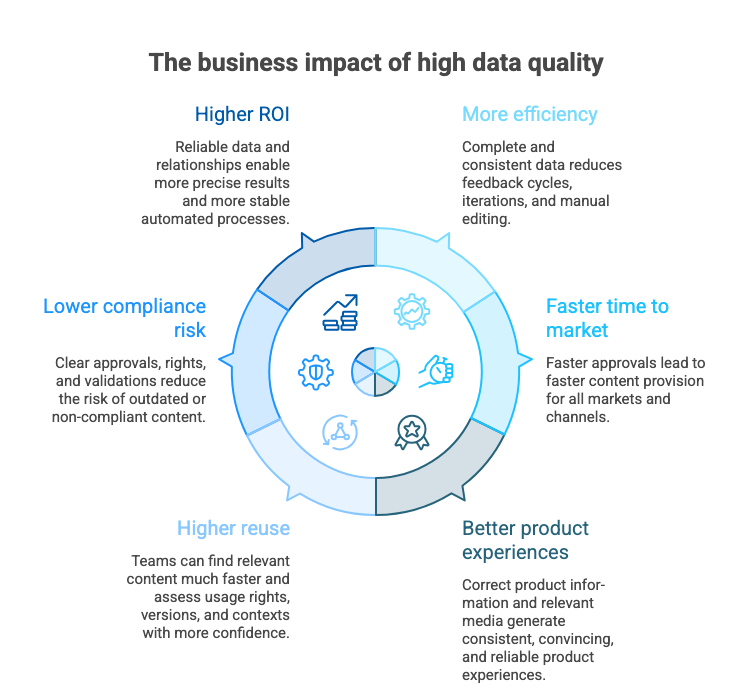
High data quality does not just improve individual pieces of content. It increases the performance of the entire content value chain and has a direct impact on costs, speed, brand consistency and customer experience.
- More efficient processes: Complete and consistent data reduces queries, correction loops and manual rework.
- Faster time to market: Faster approvals thanks to correct information and clean product context enable content to be made available earlier across all markets and channels.
- Better product experience: Correct product information and appropriate media create consistent, compelling and trustworthy product experiences.
- Greater reuse: Teams find existing content faster and can reliably assess its rights, version and usage context.
- Fewer instances of misuse: Clear approvals, rights and validity periods reduce the risk of outdated or unauthorised content being used.
- Higher ROI from AI and automation: Reliable data and relationships enable more precise results and more stable automated processes.
Why Data Quality Is the Foundation for AI Readiness
The frequently used statement that “AI is only as good as its data” is fundamentally correct, but it does not tell the whole story. What matters is which data a specific AI use case requires and how that data is used. Three levels are relevant for content operations:
1. Training and Example Data: What the AI Learns
When companies train their own models or fine-tune existing models, the quality, representativeness and consistency of the training data directly influence the outcome. They determine which patterns and relationships an AI model learns. Incorrect classifications or inconsistent examples can be systematically adopted and distort the results.
Example: An AI system is intended to automatically classify product images according to product type and usage scenario. If it is trained using correctly and consistently labelled example images, it can apply this classification logic to new assets. If the example data contains contradictory or incorrect assignments, however, the AI learns these inaccuracies as well.
2. Context and Operational Data: What the AI Bases Its Results On
Many AI applications, however, do not train their own model. Semantic search, retrieval-augmented generation (RAG) or AI agents access existing metadata, relationships, documents and rules. This data provides the AI with the current business and usage context it needs to generate relevant results or support decisions. Here, the quality of the context provided determines whether results are relevant, traceable and safe to use.
Example: A marketing employee uses AI-powered search to look for “approved product images for the summer campaign in France”. For the AI to find the right assets, information about the product, campaign, market, approval status and, where applicable, usage rights must be correctly stored and linked. The AI does not need to be retrained for this – above all, it needs the right context.
3. Process and Governance Data: What the AI Is Allowed to Do and How
As soon as AI not only processes information but also automates processes or triggers actions, a third level comes into play. Automated workflows require clear status values, responsibilities, rights and handover rules to enable permitted actions in different contexts. If this information is missing or not clearly maintained, AI cannot correct existing process errors and inconsistencies – in the worst case, it can reproduce them faster and on a larger scale.
Example: An AI agent is intended to automatically check completed product images and, once approved, distribute them to the shop, CMS and retail partners. For this to work, it must be clearly defined which quality criteria need to be met, who is authorised to approve content, for which markets usage rights exist and which systems should receive the respective assets. Only this process and governance information enables the AI not only to recognise the right content, but also to perform the right actions.
AI readiness therefore means far more than selecting a suitable AI model. For every use case, companies must ensure that the AI learns from the right foundation, accesses the right context and operates within clearly defined processes and rules. Only the interaction of these three levels creates the conditions for reliable and scalable AI applications across the content value chain.
The desired cycle: High-quality data improves AI-powered results. Controlled AI enrichment, in turn, improves metadata and processes. Human-in-the-loop reviews and measurable quality rules keep this cycle reliable.
The Role of an AI-Powered Content Value Chain Platform
A modern DAM is the foundation for the centralised management of digital assets. However, central storage alone is not enough for an end-to-end content value chain. What is needed is a platform that connects assets, product context, metadata, rights and workflows and orchestrates the flow of content across teams, markets and channels.
Automated Enrichment
AI can analyse content, suggest metadata, recognise text in images, identify similarities or generate accessible ALT text. Binding taxonomies, quality rules and approvals ensure that these results are incorporated into the data repository in a controlled manner.
Semantic and Context-Based Search
Semantic search understands natural language and content similarities. High-quality metadata and relationships nevertheless remain essential: they narrow down search spaces, provide product and usage context and help filter results according to rights, markets, versions or approval status.
Automated Workflows and Distribution
Clear process data enables automated quality checks, approvals, transformations and transfers to PIM, CMS, e-commerce platforms or other channels. This means that data quality is not only checked at the end but integrated directly into operational processes.
Intelligent Reuse
When assets are linked to products, target groups, campaigns, markets and usage rights, AI can suggest suitable content and selectively activate existing assets. This reduces duplicate production and increases the value of existing content.
Improving Data Quality in DAM: Six Practical Steps
- Define use cases and quality objectives. First, determine where and in what form the assets are required. Every data recipient has its own quality requirements, all of which must be properly reflected in the data model. This also includes compliance information for digital rights management.
- Define standards and rules. Standardise taxonomies, naming conventions, mandatory fields, formats, approval statuses and relationships. Quality rules should be specific and machine verifiable.
- Measure baseline quality. Establish a reliable baseline score for all relevant asset types, fields and processes. This makes improvements in the quality of the data repository visible.
- Cleanse and enrich existing data. Resolve duplicates, outdated values and missing relationships. AI can pre-sort large volumes of data and provide suggestions; however, changes to business-critical data should be safeguarded by clearly defined review and approval processes.
- Embed quality in workflows. Use automated validations, approvals and escalations before content is distributed to markets or channels.
- Continuously monitor and improve. Measure quality indicators on an ongoing basis and adapt rules to new products, channels, regulatory requirements and AI use cases.
Which KPIs Can Be Used to Measure Data Quality?
A data quality dashboard should focus on a small number of use-case-relevant metrics. Suitable KPIs include:
- Completeness rate: The proportion of assets or data records for which all required fields and relationships are available.
- Validation rate: The proportion of data records that comply with defined format, taxonomy and business rules.
- Duplicate rate: The proportion of potentially duplicated assets or data records.
- Timeliness rate: The proportion of content whose review or update falls within the intended timeframe.
- Distribution error rate: The proportion of transfers to channels or systems that fail due to missing or incorrect data.
- Manual rework effort: The time teams need for corrections, queries and additions.
Common Mistakes in Data Quality Initiatives
- One-off cleansing instead of continuous governance: Without rules and responsibilities, quality deteriorates again after a clean-up.
- 100 per cent completeness without a use-case focus: Mandatory fields create unnecessary effort if their value for processes and channels is unclear.
- AI without quality control: Automatically generated metadata should be reviewed using confidence scores, rules and risk-based approvals.
- Isolated system optimisation: High quality in a single system is not enough if transfers and relationships across the entire content value chain remain flawed.
- Confusing AI readiness with model training: In many cases, accessible context, clean metadata and clear process rules are more important than training a proprietary model.
Conclusion: Data Quality Makes Content Operational and AI Scalable
Data quality is not an isolated IT or maintenance project. It determines whether companies can find, safely use, efficiently distribute and intelligently reuse their digital assets. With the use of AI, its strategic value increases: it is not the sheer volume of data that creates AI readiness, but its reliability, context and integration into clearly defined processes.
An AI-powered Content Value Chain Platform such as Sharedien connects assets, product context, metadata, rights and workflows in a cloud-native platform. This makes data quality part of the operational logic and transforms content from a managed repository into a measurable value driver.
How AI-ready is your content value chain? Sharedien shows you how data quality, context and automation can be connected across your existing system landscape.
Frequently Asked Questions About Data Quality
What Does Data Quality Mean in Digital Asset Management?
Data quality in DAM describes how complete, correct, consistent, up to date and unique assets, metadata and relationships are. High-quality data makes content findable, safe to use and suitable for automated distribution.
Which Data Quality Dimensions Are Particularly Important?
For content operations, completeness, correctness, consistency, timeliness, uniqueness and context quality are particularly relevant. Their weighting depends on the respective use case.
How Can a Company Improve Its Data Quality?
Companies should define prioritised use cases, clarify responsibilities, establish standards, measure baseline quality, cleanse existing data and permanently embed quality checks in workflows.
What Role Does a DAM Play in Data Quality?
A DAM centralises assets and metadata, provides versions and rights information, and supports validations and workflows. As part of a connected content value chain, it also links assets with product context, markets and channels.
Why Is Data Quality Important for AI?
AI-powered applications require reliable training, context, operational or process data. Good data quality increases the relevance and stability of results and reduces faulty automation.
Does a Company Need to Train Its Own AI Models for AI Readiness?
No. For many AI applications, companies can use existing AI models and services. What matters more for AI readiness is ensuring that their own data is complete, structured and accessible and provides the AI with the necessary business context. Clear rules, responsibilities and processes for using AI are equally important. Companies therefore do not necessarily need to develop their own AI – above all, they need to create the conditions that allow existing AI to work reliably with their data.
About the author
Our marketing team shares current industry trends, marketing strategies and practical tips on the blog.

More
articles
Keep reading and take a look at our latest blog articles.


Guided Tour: AI Won’t Fix Your Content Chaos
.png)

Dynamic dual leadership for future growth


OMR Festival 2026: Masterclasses with Siemens and Weidmüller