

Digital Asset Management
Best Practices for Successful Retailers: Digital Asset Management in Retail
How retailers manage their product experience from supplier onboarding to the product detail page

Successful retailers manage product content as an end-to-end value chain. They secure quality as early as the onboarding of supplier data, rely on a scalable content hub, consistently link assets with product data and use them to create product experiences that inspire. They use AI wherever it noticeably improves findability and efficiency.
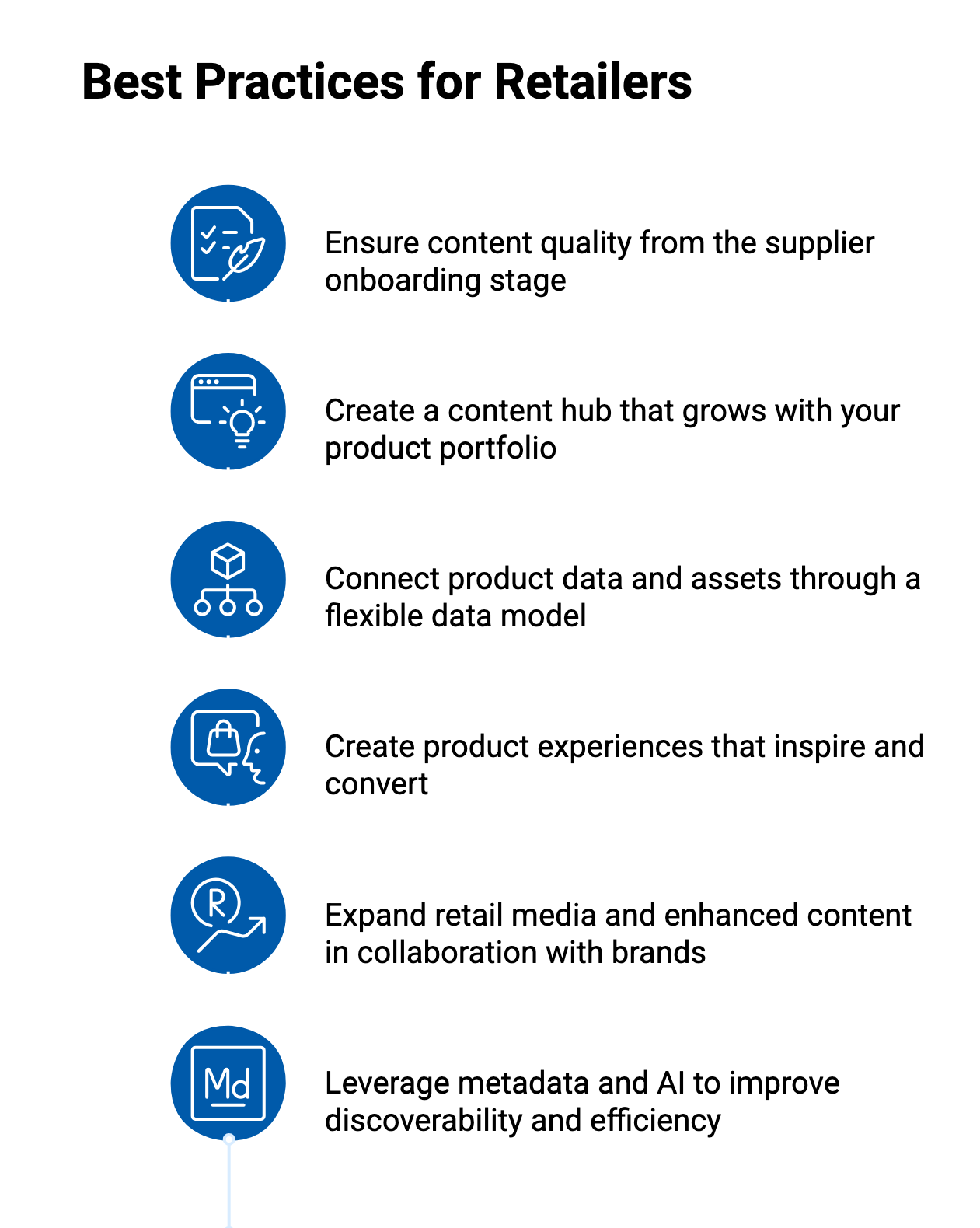
The following six best practices show what matters. They are based on experience from e-commerce projects and on the typical challenges retailers face today. Finally, a guide in six steps describes how to implement these approaches in your organisation.
Why product content has become a success factor in retail
In e-commerce, digital content takes on the role that the product itself plays in a physical store. Images, videos, descriptions and structured product data shape how customers find, compare and evaluate products. Accordingly, the amount of content per product has risen sharply in recent years, and with it the effort required for maintenance, approval and distribution.
At the same time, manufacturers and retailers are moving closer together. Marketplace models bring numerous brands and partners onto one platform, and they deliver their content in varying quality. The bottlenecks often lie less in the frontend than in data, processes and systems. A lack of transparency, manual processes and poorly aligned systems have a direct impact on time-to-market, content quality and customer satisfaction.
Best practice 1: Ensure content quality from supplier onboarding onwards
The quality of product content is determined at the beginning of the value chain. Anything that is not checked when supplier data is imported can, in the worst case, end up unfiltered in the shop, app and marketplaces, where correcting it takes considerably more effort.
Define uniform requirements for all supply channels
Suppliers provide their content through different routes, for example via a supplier portal, a GDSN data pool or an Excel import. Each channel comes with its own challenges, but the requirements for the result should be the same everywhere. For digital assets, this means clear specifications for image formats, resolution, cut-outs, video formats, mandatory metadata and usage rights. The more precisely these standards are defined and communicated, the less rework is needed later.
Automate validation rules and establish feedback loops
Automated validation rules check content for completeness and compliance directly on import. Missing views, insufficient resolution or incomplete metadata are detected before they become visible in the shop. Transparent feedback to suppliers ensures that quality improves with every delivery and takes pressure off the in-house content team.
Takeaway: Errors that are not caught during onboarding multiply in every channel. Securing quality at the beginning of the value chain saves correction effort and strengthens collaboration with suppliers.
Best practice 2: Create a content hub that grows with the assortment
In retail, digital asset management is far more than a media database. It supplies the shop, app, marketplaces and marketing with content, making it infrastructure for the core business.
From on-premises to a cloud-native data hub
Many retailers operate DAM solutions that are installed on-premises or are no longer being developed by the vendor. At the latest when the assortment and content volumes grow quickly, such systems reach their limits. Three criteria have proven their worth when selecting a new solution: the ability to manage very large data volumes with high performance, an API-first strategy for integration into the existing platform, and a cloud-native architecture that ensures speed, availability and scalability.
Marketplace strategies need scalable infrastructure
Anyone growing through marketplace partners must expect sharply rising content volumes. Each new partner brings additional products, images and variants that have to be processed without any loss of performance. On top of that, e-commerce orders come in around the clock. If the content hub is unavailable, images and information are missing exactly where purchase decisions are made.
Read our success story with OTTO
Takeaway: In retail, the DAM becomes infrastructure for the core business. A cloud-native architecture and an API-first approach are prerequisites for the platform to support growth strategies.
Best practice 3: Link product data and assets through a flexible data model
In retail, an asset only becomes fully usable once it is clear which item, which variant and which part of the assortment it belongs to. A flexible data model maps these relationships and makes them usable for people and systems alike.
Map complex relationships in a generic data model
As the assortment grows, the number of relationships between items, variants, accessories and assets increases faster than the number of products themselves. Rigid data models quickly reach their limits here. A generic data model can be extended flexibly and is able to map, maintain and manage even very large volumes of product entities, attribute values and relations.
Interplay with PIM and category management
In retail, the PIM provides the product structure and category management provides the placement within the assortment. The DAM adds the visual side and must stay in sync with both so that navigation, filters and product presentation fit together. Clean relationships also form the basis for recommendations and content combinations that enrich the shopping experience.
Go to our success story with OTTO
Takeaway: The larger the assortment, the more valuable the relationships between the data become. Consistently linking assets and product data lays the foundation for shops, recommendations and new business models.
Best practice 4: Create product experiences that inspire and sell
The product detail page is where purchase decisions are made. At the same time, customers increasingly expect the kind of inspiration online that they know from brick-and-mortar retail. Successful retailers excel in both areas.
High-quality, high-performance content on the product detail page
Images, videos, 360° and 3D views bring products to life and build trust. Complemented by customer reviews, comparisons and relevant product information, the result is a page that answers questions before they are asked. For this content to have an effect, it has to load quickly, as long loading times are considered a common reason for abandoned purchases. Automatically generated derivatives provide the right format and size for the shop, app and marketplaces.
Inspiration through content combinations
A flexible data model makes it possible to combine items from different brands into themed worlds, such as interior design ideas or complete looks. If these combinations are handed over as briefings directly from the DAM to photographers and agencies, the result is a seamless process from idea to finished image. Online, customers thus receive the kind of inspiration that a well-designed shop window or showroom would otherwise offer.
Make targeted use of cross-selling and upselling
If the items in a combination are listed and linked individually in the shop, customers can buy the entire ensemble or individual pieces of it. This opens up opportunities for upselling and bundle sales. In addition, matching accessories, alternatives and spare parts on the product detail page can support conversion and increase basket size.
Download our success story with OTTO
Takeaway: Product experiences emerge when high-quality content is delivered quickly and product data, briefing and image production come together in one system. This turns content into a revenue driver.
Best practice 5: Expand retail media and enhanced content together with brands
Retail media is one of the fastest-growing business areas in retail. Manufacturers gain visibility on the platforms where their customers shop, and retailers tap into additional revenue streams.
Enhanced content for strong brand presence
With enhanced content, manufacturers actively help shape their product detail pages. Additional images, videos, brand elements and storytelling strengthen brand perception and make products stand out from the competition. A more compelling product presentation can contribute to higher sales, which benefits retailers and manufacturers alike.
Manage advertising formats and brand content centrally
Sponsored products, banners and placements on search and category pages draw attention to specific products. For these formats to work reliably, retailers need a central hub for brand content. In the DAM, manufacturers' content is received, checked, approved and assigned run times and usage rights before it goes out to the channels.
Takeaway: Retail media needs reliable content processes. Retailers that receive, approve and distribute brand content in a structured way make their platform more attractive to manufacturers.
Best practice 6: Use metadata and AI to ensure findability and efficiency
Whether customers find the right product in the shop or content teams find the right asset, both depend on the quality of the metadata. AI can make this work considerably easier, but it requires a clean foundation.
Consistent metadata as the foundation
Uniform taxonomies across suppliers, brands and categories are the basis for powerful search and filter functions. They determine how quickly customers find what they are looking for and, at the same time, form the foundation for value-adding AI applications. A well-thought-out metadata strategy therefore belongs at the start of every digital asset management project.
Natural language search and similarity search
Modern search functions allow customers to describe their needs in their own words or to search for similar products based on an image. This makes product research more intuitive, especially in large assortments. Content teams benefit from the same principle when they find assets in the DAM via a description or a reference image instead of exact file names.
Automated tagging for large asset inventories
With very large asset inventories, fully manual tagging is hardly feasible any more. AI-powered tagging and computer vision recognise image content, add metadata and noticeably reduce the workload of the commerce team. The results should be checked against defined rules so that data quality is maintained.
Shopping agents and personalised content
AI shopping agents support customers during product research and, much like good sales staff, can contribute to purchase decisions through targeted recommendations. The personalisation of content based on purchase history and browsing behaviour is also becoming more important. Both applications require structured, machine-readable assets and product data.
Takeaway: AI only realises its full impact on a clean metadata foundation. Successful retailers prioritise use cases with measurable effects instead of launching pilot projects with no path into operations.
From analysis to implementation: introducing the best practices in six steps
The best practices described above only realise their full impact in combination. Individual optimisations are rarely enough to achieve lasting competitive advantages. What is needed is a clear objective that serves as a guardrail for investments, priorities and operational decisions. The following six steps help you approach implementation in a structured way.
Step 1: Current-state analysis
Need for action: It is unclear which systems manage which content and who is responsible for what.
First step: Document systems, content flows and responsibilities from the supplier to the shop.
Step 2: Defining objectives
Need for action: Projects run in parallel without shared priorities among stakeholders.
First step: Set two to three measurable objectives, such as time-to-market, content completeness or conversion, and prioritise the best practices accordingly.
Step 3: System architecture
Need for action: Workarounds bridge a fragmented or outdated system landscape.
First step: Define the content hub as the central component and plan interfaces to the PIM, shop and marketplaces on an API-first basis (best practices 2 and 3).
Step 4: Process design
Need for action: Onboarding, approval and distribution are handled manually and across different tools.
First step: Automate the onboarding of one supplier group as a pilot (best practice 1).
Step 5: Data governance
Need for action: Quality rules are inconsistent and responsibilities are unclear.
First step: Define clear rules and responsibilities and safeguard them with automated quality checks. This also increases investment security for AI use cases (best practice 6).
Step 6: Continuous optimisation of the product experience
Need for action: Online sales are stagnating or declining as competition grows ever stronger.
First step: Enrich product content comprehensively and make it flexibly usable through linked relationships. Give brands the opportunity to show their products in the best light – and, where appropriate, even create additional business models with retail media (best practices 4 and 5).
Which best practices you tackle first depends on your biggest bottleneck. If your team is struggling mainly with faulty supplier data, best practice 1 is the obvious starting point; if your existing system is reaching its limits, the journey begins with best practice 2.
Conclusion: product content as a competitive advantage in retail
In retail, data quality, scalable infrastructure, linked product data, inspiring product experiences and AI are closely intertwined. Retailers that manage these building blocks as a coherent value chain create consistent product information across all channels, shorten time-to-market and open up new revenue potential, for example through retail media or cross-brand inspiration worlds.
As the Driver of the Content Value Chain, Sharedien connects these building blocks on a cloud-native platform with an open integration architecture and integrated AI services. The result is a content hub that grows with the assortment, marketplace partners and channels.
Go to our success story with OTTO
Would you like to talk to our experts about your requirements, or would you like to arrange a reference call with one of our customers? Contact us at any time, with no obligation!
Frequently asked questions (FAQ)
What role does digital asset management play in retail?
In retail, the DAM is the central content hub that supplies the shop, app, marketplaces and marketing with images, videos and documents. It links assets with product data, provides channel-specific formats and manages approvals and usage rights. As assortments grow and marketplace models expand, it becomes business-critical infrastructure.
How do retailers improve the quality of supplier content?
The most effective measure is clear, uniform requirements for all supply channels, combined with automated validation rules on import. This way, missing views, insufficient resolution or incomplete metadata are detected before they appear in the shop. Transparent feedback loops help suppliers improve their content over the long term.
How does a DAM support retail media and enhanced content?
A DAM serves as the hub for manufacturers' content. Enhanced content and advertising materials are received, checked, approved and assigned run times and usage rights there. This allows retail media formats to be delivered reliably and in line with brand guidelines.
How can content drive cross-selling and upselling?
The basis is clean relationships between items, variants and accessories in a flexible data model. Building on this, retailers can showcase cross-brand combinations such as interior design ideas or complete looks, with each item linked individually in the shop. In addition, accessories, alternatives and spare parts on the product detail page can increase basket size.
Which AI applications pay off in retail digital asset management?
Automated tagging and computer vision for maintaining large asset inventories are particularly practical, as are natural language search and similarity search for customers and content teams. In the medium term, AI shopping agents and the personalisation of content are becoming more important. A consistent metadata foundation is a prerequisite for all of these applications.
Why should a DAM for marketplaces be cloud-native?
Marketplace models cause content volumes to grow quickly and unpredictably. A cloud-native platform scales with this growth without losing performance and offers the high availability that an online shop running around the clock requires. Thanks to an API-first architecture, it can also be integrated flexibly into existing platforms.
About the author
As Senior Marketing Manager, Tina leads content strategy at Sharedien. With over 7 years of experience in B2B SaaS marketing, she develops editorial plans, campaigns, and formats that make complex topics clear and impactful. LinkedIn

More
articles
Keep reading and take a look at our latest blog articles.


Sharedien and Y1 announce new partnership!



AI won't fix your content chaos. It amplifies it.