
Innovation Technology & Integrations
What Is the Difference Between Cloud-hosted, Cloud-ready and Cloud-native?
Definitions, comparisons and business impact of modern cloud architectures

Cloud technologies have fundamentally changed the software landscape. Today, applications are increasingly delivered via the cloud, computing power can be sourced flexibly and new services can be made available considerably faster. Particularly in extensive and data-intensive content value chains, the cloud opens up new ways to process large volumes of data, scale systems and connect digital services with one another.
However, the term "cloud" on its own says little about how a piece of software is technically built and which advantages it can actually draw from a cloud infrastructure. Cloud-hosted, cloud-ready and cloud-native describe different stages of technological development and indicate whether software was made available for the cloud retrospectively or developed from the ground up for cloud environments. These differences affect, among other things, scalability, integration capability, updates, resilience and the incorporation of new AI services. For companies evaluating a new DAM system today, the underlying cloud architecture is therefore one of the important selection criteria.
Key points at a glance
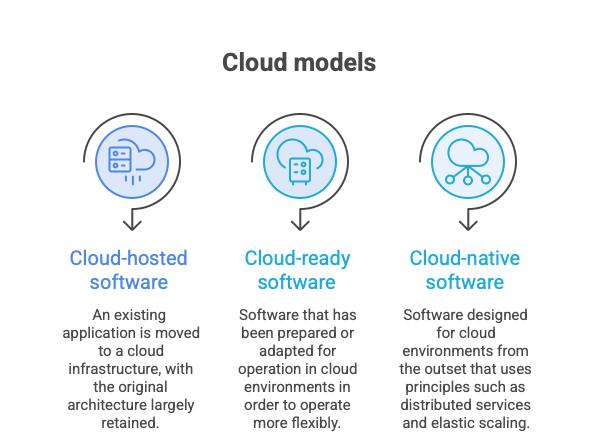
- Cloud-hosted: Software that was usually originally developed for traditional infrastructures is operated on a cloud infrastructure. The cloud primarily takes on the role of the hosting environment.
- Cloud-ready: The software has been adapted or prepared for operation in cloud environments and can use selected cloud functions. How comprehensively the advantages of the cloud can be exploited depends on the respective architecture.
- Cloud-native: The software was developed from the ground up for cloud environments. Cloud functions such as elastic scaling, distributed availability and API-based integration are typically part of the architecture.
- Technical difference: The models differ primarily in how deeply cloud principles are anchored in the software architecture. This ranges from merely hosting an existing application to an architecture developed consistently for the cloud.
- Business impact: As the degree of cloud-nativeness increases, the options for scaling applications flexibly, developing them further more quickly and integrating new cloud and AI services generally increase as well.
Cloud-hosted vs. cloud-ready vs. cloud-native: the differences in direct comparison
The three terms provide indications of a software's origin, how its architecture is structured and to what extent it can use the technical capabilities of a cloud environment.
Cloud-hosted
- Basic principle: Existing software is operated on a cloud infrastructure.
- Origin: Usually traditional on-premises software.
- Architecture: Often monolithic and largely unchanged compared with the original architecture.
- Use of the cloud: The cloud serves primarily as a hosting environment.
- Scaling: Often manual or through additional infrastructure.
- Updates: Usually traditional release and update cycles.
- Resilience: Heavily dependent on the original architecture.
- Integration: APIs and integrations were often added retrospectively.
- Further development: Changes can affect larger parts of the system.
- AI & new services: Integrating additional AI and cloud services can require greater adaptation effort.
- Business impact: Companies benefit from cloud operation, while the fundamental characteristics of the existing software architecture are largely retained.
Cloud-ready
- Basic principle: The software has been adapted or prepared for operation in a cloud environment.
- Origin: Often originally developed for traditional infrastructures.
- Architecture: May be modernised, but uses cloud principles only partially.
- Use of the cloud: Selected cloud functions can be used.
- Scaling: Scaling is possible but may be subject to limitations depending on the architecture.
- Updates: Release and update processes depend on the architecture and operating model.
- Resilience: The software may be optimised for higher availability.
- Integration: APIs and modern integrations are possible.
- Further development: More flexible than traditional legacy architectures.
- AI & new services: External AI and cloud services can be connected.
- Business impact: Companies can use some of the advantages of modern cloud infrastructures.
Cloud-native
- Basic principle: The software was developed from the ground up for cloud environments.
- Origin: Designed from the outset for operation in the cloud.
- Architecture: Modular and designed for distributed cloud architectures.
- Use of the cloud: Cloud functions are consistently integrated into the architecture.
- Scaling: Resources can be scaled elastically and according to demand.
- Updates: With cloud-native SaaS, continuous development and delivery ("rolling releases") are typically possible.
- Resilience: Resilience and distributed availability are typically part of the design.
- Integration: API-based integration is a fundamental component of the architecture.
- Further development: Components and services can be developed further largely independently.
- AI & new services: The architecture provides a very good basis for the flexible integration and scaling of AI and cloud services.
- Business impact: High scalability, capacity for innovation and flexibility help companies adapt their software landscape to new requirements.
Put simply: cloud-hosted means that software runs in the cloud. Cloud-ready means that software is prepared for operation in the cloud. Cloud-native means that software was built for the cloud.
Sharedien is a cloud-native SaaS solution for which maintenance, hosting and updates are handled entirely for you.
Cloud: The last major evolution and enabler of AI
The development of enterprise software can be viewed as a gradual decoupling of applications from physical infrastructure. Traditional on-premises systems were developed for defined server environments and operated in a company's own data centre or on dedicated infrastructure. With cloud-hosted models, the place of operation shifted first: existing applications could be migrated to cloud infrastructure without their architecture having to be fundamentally changed.
Cloud-ready software went one step further. Applications were adapted so that they could make better use of certain cloud functions and operating models. Cloud-native software already anchors these principles in its architecture. As a result, resources, services and components can be provisioned, connected and scaled far more flexibly.
This development is becoming even more significant with the growing use of artificial intelligence. AI applications often require dynamically available computing power, access to different data sources and the ability to incorporate specialised models and services flexibly. Cloud infrastructure is thus increasingly becoming the technical foundation of a software landscape in which traditional business applications and AI services work closely together.
The advantages of the cloud
Cloud infrastructures enable companies to provision IT resources according to demand and to operate applications more flexibly. Computing power and storage can be adapted to changing requirements, while centrally provided services can reduce the effort required for operations and infrastructure management.
This flexibility becomes particularly relevant for applications with strongly fluctuating data volumes or usage peaks. A DAM, for example, must not only store millions of assets but simultaneously process uploads, downloads, transformations, metadata processes and the delivery of media to different channels. The cloud creates the infrastructural basis for handling such requirements more dynamically.
In addition, specialised cloud services are available. Companies can, for example, integrate services for search, data processing, content delivery or artificial intelligence into their system landscape. How much a specific piece of software can benefit from this, however, depends heavily on its architecture.
MACH: Why cloud-native is only one part of modern software architecture
Cloud-native is closely linked to modern architectural principles but does not describe them completely. In the enterprise software environment, the term MACH, among others, has become established for this. The acronym stands for microservices-based, API-first, cloud-native SaaS and headless.
Microservices allow an application to be divided into specialised services that can be developed and scaled largely independently. API-first means that interfaces are a fundamental part of the software design and that functions and data are systematically made available to other applications. Cloud-native SaaS uses the capabilities of modern cloud infrastructures as the basis of the operating model. Headless separates back-end functions from the user interface, making it easier to provide data and functions to different touchpoints.
Together, these principles support a modular software landscape in which applications do not function as isolated systems but as components of a connected digital ecosystem. This integration capability is particularly relevant for DAM, because assets are now needed in numerous applications, channels and processes.
As a cloud-native SaaS solution with an API-first and headless architecture, Sharedien is MACH-certified.
Reality check: not all clouds are equal
The label "cloud" is used in the software market for very different technological approaches. An application can be delivered entirely via the internet and still be based on an architecture originally developed for operation on individual servers or in a traditional data centre.
When selecting a new solution, the important question is therefore how the software is technically built, how it scales, how updates are delivered, which integration options exist and how flexibly additional services can be incorporated – not whether a vendor labels its solution with the predicate "cloud".
Cloud-native digital asset management: Why architecture is particularly relevant for DAM
Digital asset management places particular demands on the technical infrastructure. Companies are managing ever larger volumes of high-resolution images, videos, documents, 3D files and other digital assets. At the same time, this content must be processed, enriched with metadata, searched, transformed and delivered across numerous systems and channels.
Usage volumes can fluctuate considerably. Campaigns, product launches or seasonal peaks can place significantly higher demands on computing power, storage and delivery at short notice. A cloud-native DAM architecture can scale resources according to actual demand, thereby creating a basis for high performance even as asset inventories grow.
Connectivity is equally important. DAM systems are part of a content value chain and exchange data with PIM, MDM, CMS, shop systems, e-commerce platforms, creative tools and marketing technologies. An API-based, modular architecture makes it easier to integrate the DAM into this landscape and to provide digital assets wherever they are needed.
The business impact of cloud-native DAM solutions
The technical characteristics of a cloud-native architecture have a direct effect on the options companies have for shaping their content processes. Elastic scaling supports growing data volumes and usage peaks without infrastructure for maximum load having to be kept available permanently. API-based integrations make the automated exchange of assets and metadata between different systems easier.
A modular architecture also creates greater flexibility in the further development of the system landscape. New channels, applications or services can be connected without completely rebuilding existing processes. Shorter release cycles additionally allow software vendors to deliver new functions more quickly.
For companies, this results in a technical basis on which content processes can be scaled and adapted to new requirements. This is especially relevant when asset volumes, channels and digital touchpoints are growing continuously.
Why cloud-native is becoming the foundation for AI readiness
Artificial intelligence significantly expands the functional scope of modern DAM systems. Automatic tagging, semantic search, image recognition, content generation, automatic derivatives or AI-assisted quality checks can already support individual steps within the content value chain today.
As the use of such functions increases, however, so do the demands on infrastructure and integration. AI models require computing power, access large volumes of data and are often provided as external or specialised cloud services. A cloud-native architecture makes it easier to incorporate such services flexibly and to scale the required resources in line with actual usage.
AI readiness encompasses more than the availability of individual AI functions. A DAM must make assets and metadata available in a structured way, support integrations and be able to embed new services into existing processes. The architecture therefore largely determines how quickly new AI applications can be integrated productively into a company's content processes.
With the growing spread of AI agents, the Model Context Protocol (MCP) is gaining importance alongside traditional APIs. An MCP server provides the functions and context of a DAM in a standardised form for AI applications. This allows agents, for example, to search for assets, retrieve metadata, understand relationships between assets and products or – within defined permissions – trigger actions and workflows in the DAM. Companies therefore do not have to develop such access individually for every AI model and every use case. For modern DAM solutions, MCP is thus becoming an important building block of AI readiness.
Conclusion: Anyone looking for a new DAM today should start with the vendors' cloud strategy
When selecting a modern digital asset management system, it is worth taking a close look behind the cloud label. Cloud-hosted, cloud-ready and cloud-native describe different technological starting points that have a long-term influence on scalability, integration capability, further development and AI readiness.
Companies should therefore clarify during the evaluation process how the architecture of a DAM is actually structured. This includes questions about scaling mechanisms, APIs, release processes, availability, integration concepts and the incorporation of external cloud and AI services. This makes it possible to assess whether a solution is merely operated in a cloud environment or consistently uses its capabilities for modern content processes.
This distinction is particularly relevant for a DAM that will be used over the long term. Asset volumes and the number of channels, integrations and AI applications will continue to grow. The chosen architecture should support this change and give companies sufficient scope to develop their content value chain continuously.
FAQs
1. What does cloud-ready mean?
Cloud-ready refers to software that has been prepared or adapted for operation in a cloud environment. It can use selected cloud technologies and modern integration mechanisms. How comprehensively cloud functions are used depends on the respective architecture.
2. What does cloud-native mean?
Cloud-native refers to software that was developed from the ground up for cloud environments. Typical characteristics are a modular architecture, elastic scaling, automated deployment, distributed availability and a strong API orientation.
3. What is the difference between cloud-ready and cloud-native?
Cloud-ready software has been prepared or adapted for operation in the cloud. Cloud-native software, by contrast, was developed with cloud principles as part of its fundamental architecture from the start. As a result, it can typically use cloud resources and services more comprehensively and dynamically.
4. Is SaaS automatically cloud-native?
No. SaaS initially describes a delivery and usage model in which software is offered as a service. An application originally developed for traditional infrastructures can also be operated as SaaS. Whether it is cloud-native depends on its technical architecture.
5. How can you recognise cloud-native software?
Indications of a cloud-native architecture include elastic scaling, modularly structured services, API-based integration, automated deployment and operating processes, and an architecture designed for distributed cloud infrastructures.
6. What advantages does cloud-native software offer companies?
Cloud-native software can help companies scale applications flexibly, deliver new functions more quickly and integrate external services more easily. The specific business impact depends on the respective software, architecture and usage.
7. Why is cloud-native important for digital asset management?
DAM systems must process large and growing asset inventories, deliver content to numerous channels and connect with PIM, MDM, CMS, e-commerce and creative systems. Cloud-native architectures provide a scalable technical foundation with strong integration capabilities for this.
8. Is cloud-native important for AI and AI readiness?
Cloud-native architectures make it easier to integrate and scale AI services, as computing resources can be provisioned flexibly and external services can be incorporated via APIs. Data quality, metadata, governance and clearly defined processes also play a central role in AI readiness.
9. Is Sharedien cloud-native?
Yes, Sharedien is cloud-native. As a modern DAM platform, Sharedien is designed for cloud operation and for integration into digital system landscapes. For a robust technical assessment, the specific architecture, the operating model and the available integration and scaling mechanisms should be examined during an evaluation.
10. Is all cloud software cloud-native?
No. Software can be operated in a cloud without having been developed as cloud-native. Cloud-hosted applications, for example, use the cloud primarily as a hosting environment. What determines whether software qualifies as cloud-native is how deeply cloud principles are anchored in its architecture.
About the author
The Sharedien product team provides insights into the latest trends, innovations, releases and best practices.

More
articles
Keep reading and take a look at our latest blog articles.


The 2025 Sharedien Market Performance Wheel from TGOA

.jpg)
.jpg)
OCR technology: text-in-image search and automated tagging


DAM Integration Made Easy