
Digital Asset Management
Best Practices for Successful Brands: Digital Asset Management in Practice
Eight success factors from the day-to-day practice of successful brands

Brands that confidently manage their content across channels, markets and partners treat product content as a genuine value chain. They rely on a single source for all assets, link images and documents to their product context, integrate their digital asset management openly into the system landscape, automate output to print and digital channels and use AI wherever it noticeably eases day-to-day work.
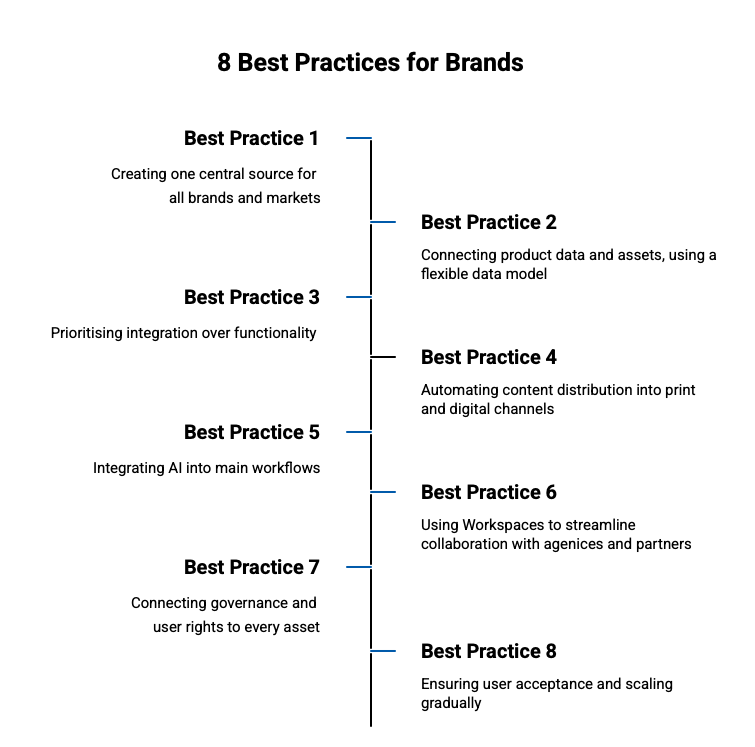
The following eight best practices are based on real experience from Sharedien customer projects, ranging from an international consumer goods group to a globally operating industrial company. A three-phase guide at the end shows how you can transfer the approaches described to your own organisation.
What successful brands do differently in digital asset management
The content value chain covers every step a digital asset goes through: from creation and enrichment through management and approval to distribution across all channels and reuse. Each step builds on the previous one: if the connection breaks at any point, this has an immediate impact on brand consistency, time-to-market and efficiency.
In many companies, this chain is broken. Either there is no central core system, so content is scattered across network drives, agency repositories and local folders, or the existing solution has reached its limits. In-house developments, on-premise solutions and process landscapes that have grown over the years with a high share of manual work often can no longer keep pace with growing asset volumes, new channels and the requirements for integration and performance. The consequences are often duplicated work, manual assignments and content that reaches the channel too late or with errors.
Whatever a company’s starting point, there is a set of core principles that reliably turns a Sharedien migration into real business success. These principles can be applied to companies of any size and in any industry.
Best practice 1: Create a single source for all brands and markets
A single source means that all brands, markets and partners access the same, up-to-date asset inventory. This prevents duplicates and outdated versions without local teams losing their ability to act.
Manage multiple brands separately and control them in one system
Companies with a broad brand portfolio face a conflict of objectives: each brand needs its own identity and its own content, while global marketing needs to keep the overall view. A proven approach is a system in which brands are managed clearly separately but sit on a shared platform. Markets access precisely the assets relevant to them, while brand teams centrally control what is approved. At the same time, content reuse increases, which has a direct effect on the cost-efficiency of content production.
Go to the success story with Beiersdorf
A shared view for national subsidiaries and sales partners
Globally operating manufacturers with numerous subsidiaries and an extensive dealer network benefit from a 360° view of all assets. When national subsidiaries, sales and trading partners draw on the same source, local parallel repositories and time-consuming alignment on the current status are no longer needed. New products thus launch in all markets with consistent content.
Read our success story with Kärcher
Takeaway: Central control and local autonomy are not mutually exclusive. A single source gives each market exactly the content it needs for its context, while the brand remains consistent across all channels.
Best practice 2: Link product data and assets via a flexible data model
An asset is only fully usable once it is clear which product, which variant and which channel it belongs to. A flexible data model maps these relationships and makes them usable for people and systems alike.
The right asset for every product variant
Manufacturers with extensive, variant-rich ranges need the right images, data sheets, certificates or CAD files for every version. A granular data model maps even complex relationships and assigns assets to variants automatically. Downstream systems receive the matching content via interfaces, so product pages, catalogues and dealer portals are always supplied with up-to-date data.
Direct access to our success story with Weidmüller
Make relationships between products and assets visible
Links only help if users can see them. A clear view of the relationships between products and images makes everyday work easier, for example when a product manager wants to check which assets are assigned to an item or where an image is used. This reduces queries and errors, especially with large asset inventories.
Go to the success story with Kärcher
Product communication based on connected data
For many manufacturers, all product communication depends on how well assets and product information are connected. Without this connection, images have to be assigned manually for every catalogue and every price list, an effort that grows with each new product and each new channel. When the data is well connected, communication materials for all channels can be generated from the same inventory.
Read the success story with wedi
Takeaway: Assets only unfold their value in the product context. Linking variants, data sheets and images via a flexible data model avoids manual assignment and ensures that the right product information reaches every channel.
Best practice 3: Prioritise integration over feature scope
A DAM only delivers its full benefit when content reaches the systems where it is needed without manual intermediate steps. During selection and implementation, it therefore pays to put integration capability ahead of individual features.
Many systems on a common foundation
Corporations with system landscapes that have grown over decades face a particular challenge when replacing a legacy DAM. A proven approach is to first create a robust technical foundation and to connect assets and product data via a central integration layer. Once this foundation is in place, further systems can be connected quickly, often with standard functionality and without custom adaptations.
Go directly to the success story with Siemens
Seamless integration with PIM, PLM and CMS
In many industrial companies, assets have historically been spread across several places, for example in an older DAM and in the PLM system, in addition to separate areas for internal and external users. When these silos are merged into one platform and connected to PIM, PLM and CMS, synchronisation delays disappear. Approved content is immediately available wherever it is needed.
Read the success story with Weidmüller
Bidirectional exchange with the PIM and access from creative tools
PIM and DAM complement each other best when data flows in both directions. A bidirectional interface ensures that product information and assets remain consistent in both systems. Integration does not stop at back-end systems: when office applications and creative tools such as Adobe Creative Cloud are connected, users can access approved media without leaving their familiar working environment.
Go directly to our success story with wedi
Takeaway: API-first prevents media disruptions, and integration extends all the way into the tools of creative teams. Creating an open foundation early on makes it much faster to implement future use cases.
Best practice 4: Automate output to print and digital channels
When print and digital channels are supplied from the same source, there is no need to compile content manually for each individual output. This saves time and ensures that all channels show the same status.
Catalogues and price lists from a single source
In many companies, print catalogues and international price lists are among the most time-consuming recurring projects. With PIM and DAM working together, their creation can be largely automated: the PIM supplies the product information to the print processes, the DAM the matching assets. The same data basis also supplies trading partners and electronic catalogues.
Read our success story with wedi now
Automated publication workflows for national subsidiaries
Internationally operating manufacturers have to provide country-specific content for every national subsidiary. Automated publication workflows distribute this content via the respective channels without each subsidiary having to compile its own materials. Local adaptations remain possible, while the foundation is the same for everyone.
Go to the success story with Kärcher
Support industry standards such as BMEcat
In B2B business, wholesalers require product data and assets in standardised exchange formats such as BMEcat. When catalogues are exported in this format directly from the DAM, there is no need for manual preparation for each trading partner. Especially for extensive catalogues with many assets and complex classifications, this is a considerable efficiency gain.
Go directly to the success story with Weidmüller
Takeaway: Print and digital draw on the same source, and manual assignment is no longer needed, even for classifications and complex industry standards.
Best practice 5: Integrate AI into day-to-day work in a targeted way
AI in digital asset management adds value when it makes specific everyday tasks easier. Today, the most effective use cases relate to search, tagging and the quality of metadata.
Image search in natural language
Marketing and brand teams often know exactly which motif they need, but not what the file is called or exactly how it was tagged. An AI-powered search in natural language finds suitable visuals based on a description, complemented by automatic tagging. This speeds up concept development and campaign planning because teams get to the right asset quickly.
Read our success story with Beiersdorf
Similarity search by colour, texture and motif
With similarity search, a single reference image is enough to find comparable assets by colour, surface texture or motif. Users can also search with everyday terms such as ‘bright bathroom with natural stone’ without every image having had to be tagged manually beforehand. Existing assets are therefore reused more often, and new productions can be planned more precisely.
Download the latest success story with wedi now
AI for automation and data quality
Beyond search, AI supports the enrichment and maintenance of metadata. Automated processes recognise image content, add attributes and uncover gaps, which improves data quality across the entire inventory. For many companies, integrated AI capabilities are therefore already an important selection criterion when deciding on a DAM platform.
Read the success story with Weidmüller!
Takeaway: AI is effective where it is embedded in existing processes. Clearly defined use cases with measurable time savings lay the foundation for further automation.
Best practice 6: Bring collaboration with agencies and partners together in workspaces
Besides internal teams, content production usually involves agencies, photo studios, national subsidiaries and specialist departments, and every handover is a potential source of error. Workspaces bring this collaboration together where the assets are managed anyway.
Briefing, storage and approval in one place
Internal and external project participants are invited to workspaces on a targeted basis. There, they receive their briefing, store the assets produced and approve them directly. Marketing teams, in-house studios and external agencies thus work in a shared process, and approved content is available in Sharedien without any further file transfer.
Go to the success story with Beiersdorf
Structured ordering processes for product assets
In large organisations, specialist departments regularly order new product images, graphics or videos. When these orders are handled via workspaces, briefings are accessible to everyone involved and communication remains traceable. Review and approval steps follow a defined workflow instead of being spread across emails and meetings.
Go straight to our success story with Siemens
Involve national subsidiaries and agencies together
Large internationally operating companies also benefit from this approach. External agencies and national subsidiaries can work directly with the central marketing team via workspaces and no longer exchange files and feedback through different channels. Marketing keeps track of all ongoing projects.
Go directly to the success story with wedi
Takeaway: When briefing, feedback, approval and storage take place in the same system in which the assets are managed, email loops and media disruptions disappear. Partners work faster, while the brand retains control over content and access.
Best practice 7: Anchor governance and usage rights directly in the asset
Usage rights, licence periods and approval status are among the biggest risks when handling image material. The more markets and partners access content, the more important it is not to maintain this information separately from the asset.
Rights, expiry dates and approval status on the asset
When image rights are managed centrally in the DAM, licence information, expiry dates and approval status remain permanently linked to the respective asset. With every access, users can see whether and for what purpose they may use an image. When a licence expires, the asset can be flagged or blocked before it becomes a problem in a channel.
Now read our success story with Beiersdorf
Takeaway: Governance works when it is part of the asset and does not have to be checked retrospectively. Markets and partners then only use approved content without brand management having to check every use.
Best practice 8: Secure acceptance and scale step by step
The best platform achieves little if it is not used in everyday work. Successful DAM projects therefore plan for acceptance and further development from the outset.
User experience as a project goal
When a new system replaces a familiar solution, usability determines whether users switch or keep maintaining old repositories. Companies that explicitly make high acceptance through good user experience a project goal create the conditions for a fast and smooth replacement of the legacy solution.
Go to the success story with Kärcher
Fast go-live and independent further development
A clearly defined project scope makes it possible to complete even extensive migrations within a few months. If the company’s own IT team is actively involved in configuration, data modelling and interface development, the company can subsequently develop the platform further itself and implement new use cases without long dependencies.
Read the success story with Weidmüller
Success factors in distributed project teams
In corporations in particular, project management and specialist departments often work at different locations. A clearly defined project scope, open communication and strong management support keep such projects on track. Connecting further systems swiftly after the first milestone uses the momentum gained for scaling.
Go directly to the success story with Siemens
Takeaway: A DAM project is successful when people enjoy using the system and the organisation itself can develop it further. A clearly defined start, an intuitive interface and early successes build the confidence to connect further systems, markets and use cases step by step.
From analysis to implementation: How to transfer the best practices to your organisation
Not every organisation has to implement all eight best practices at the same time. A proven sequence can be derived from our numerous customer projects: first, the foundation is laid with a single source, linked data and integration; automated processes build on this; and finally, the solution is anchored and scaled within the company. For each best practice, you will find a typical sign that action is needed and a concrete first step.
Phase 1: Lay the foundation
Single source (best practice 1)
Need for action: Countries or agencies maintain their own repositories, and the same images exist several times.
First step: Record storage locations and determine which brands and markets will be consolidated first.
Link product data (best practice 2)
Need for action: Product images are assigned manually for catalogues or shops.
First step: Define the most important relationships such as product, variant and asset type, and use existing structures from PIM or PLM.
Integration (best practice 3)
Need for action: Assets only reach the PIM, CMS or shop via manual uploads or with a delay.
First step: Prioritise systems, define a roadmap and start with the most important system.
Phase 2: Automate and simplify processes
Automate output (best practice 4)
Need for action: Print and digital teams work with different versions.
First step: Automate the most time-consuming recurring output, such as the print catalogue, as a pilot.
AI in everyday work (best practice 5)
Need for action: Searching for assets takes too long because assets cannot be found without the exact file name.
First step: Introduce a use case such as natural-language search and measure the time saved.
Workspaces (best practice 6)
Need for action: Briefings and approvals are spread across emails, transfer tools and meetings.
First step: Move an ongoing agency project into a workspace.
Governance (best practice 7)
Need for action: Usage rights are maintained in spreadsheets or only checked as an afterthought.
First step: Start with the asset groups that carry the highest rights risk, such as model or agency photos.
Phase 3: Secure acceptance and scale
Acceptance and scaling (best practice 8)
Need for action: Shadow repositories emerge, and every change requires external support.
First step: Define KPIs such as search time or reuse rate and measure them continuously.
Where you start depends on the biggest bottleneck in your organisation. If product images are still assigned manually, best practice 2 is the obvious starting point; if central systems are not connected, the journey begins with best practice 3.
Conclusion: Manage content as a value chain
Whether an international consumer goods group, a globally operating industrial company or a mid-sized business: companies have different starting points, product ranges and organisational structures. What they have in common is that they need to understand and manage content as an end-to-end value chain, from creation and linking with product data to automated distribution across all channels. The result is consistent brand presence, shorter time-to-market and teams that can focus on creative and strategic tasks.
As the Driver of the Content Value Chain, Sharedien brings these building blocks together on a cloud-native platform with an open integration architecture and integrated AI services. This creates a foundation that grows with new brands, markets and channels.
Would you like to know how other companies manage their content value chain with Sharedien? All success stories are available for download.
Or talk directly to our experts about your requirements or to arrange a reference call with our customers.
Frequently asked questions (FAQ)
What are the most important best practices in digital asset management for brands?
Successful brands create a single source for all brands and markets, link assets to product data via a flexible data model and integrate Sharedien API-first with PIM, PLM, CMS and creative tools. Building on this, they automate output to print and digital channels, use AI for search and tagging, bring collaboration with partners together in workspaces and anchor usage rights directly in the asset. High user acceptance and step-by-step scaling secure long-term success.
How long does it take to replace an existing DAM system?
The duration depends on the volume of assets, the number of systems to be connected and the complexity of the data model. With a clearly defined project scope and a cloud-native platform, a go-live with Sharedien within a few months is realistic, even for extensive migrations. Further systems, markets and use cases can then be connected step by step.
Why is linking product data and assets so important?
Only the link to product and variant makes an asset correctly usable in all channels. Without it, images, data sheets and CAD files have to be assigned manually for every catalogue, shop or dealer export, which increases effort and the risk of errors with every new product. A flexible data model ensures that the right content automatically arrives in the right context.
How do PIM and DAM work together when creating catalogues?
The PIM supplies the structured product information, Sharedien the matching images, graphics and documents. Via a bidirectional interface, both systems stay in sync, so print catalogues, price lists and electronic catalogues are created automatically from the same data basis. For wholesale, the data can also be exported in standard formats such as BMEcat.
Is an enterprise DAM also worthwhile for large internationally operating companies?
Yes, because the challenges are similar: growing asset volumes, multiple channels, international partners and the wish for automated processes. A cloud-native and scalable SaaS platform such as Sharedien requires no in-house infrastructure and grows with the requirements. Large internationally operating companies in particular benefit from automated catalogue creation and integration with PIM and creative tools, because this noticeably relieves their teams.
What role does AI play in modern content management?
AI primarily speeds up the search for and maintenance of assets. Natural-language search, similarity search and automatic tagging help teams find suitable content quickly and reuse existing assets more often. AI also improves data quality by adding metadata and uncovering gaps.
How can agencies and external partners be involved securely?
Via workspaces in Sharedien, agencies and partners receive targeted access to the content and projects that concern them. Briefing, storage, feedback and approval take place in the same system in which the assets are managed. Roles, permissions and usage rights stored on the asset ensure that the brand retains control over content and access at all times.
About the author
Our marketing team shares current industry trends, marketing strategies and practical tips on the blog.

More
articles
Keep reading and take a look at our latest blog articles.


How DAM supports your brand management


Composable or monolithic: Why system architecture determines AI flexibility


AI won't fix your content chaos. It amplifies it.