Content Hub
What role does integration capability play in digital asset management (DAM)?
Definition, business benefits and prerequisites

Digital asset management today is far more than a central repository for images, videos and documents. In modern organisations, a DAM system forms the heart of an end-to-end content value chain, in which digital assets are created, enriched, managed, distributed and continuously reused. However, for content to deliver its maximum business value, a DAM must never be viewed in isolation. Only seamless integration into the existing system landscape ensures that content flows between teams, processes and applications without disruption. As the driver of the content value chain, integration capability is therefore deeply embedded in Sharedien’s DNA.
In practice, however, isolated software solutions remain one of the greatest obstacles to an efficient content strategy. Assets are stored multiple times, data has to be transferred manually between systems, and employees spend valuable time searching for information or maintaining redundant content. At the same time, the lack of integrations prevents automated workflows and significantly limits the use of artificial intelligence. The result is longer time-to-market, higher process costs and an inconsistent customer experience across different channels.
A modern digital asset management system must therefore do far more than simply manage digital assets. As the central hub of a connected content value chain, a DAM must intelligently connect content with product data, e-commerce platforms, creative applications and other enterprise systems. Only when information is available across systems can organisations automate their content processes, reuse assets multiple times and bring content to market much faster. Sharedien deliberately leverages AI as a competitive advantage: automatic asset enrichment, intelligent tagging and AI-powered search enable teams to continue working immediately.
"For Beiersdorf, intelligent management of the content supply chain is essential for the performance of our campaigns and for smooth internal processes. With AI and Sharedien DAM, we are taking efficiency, scalability and creativity to a new level – a true game changer for our global marketing operations."
Jasmin Quellmann, Head of MarTech & AI at Beiersdorf
The integration capability of a DAM system is therefore no longer merely a technical detail, but a fundamental prerequisite for efficient business processes and sustainable business success. It determines whether content is simply managed or becomes a genuine value driver for marketing, sales, e-commerce and product communication.
Global organisations such as Beiersdorf, the OTTO Group, Liebherr, Siemens and Schüco rely on Sharedien to make their content processes more efficient and to use digital assets as a strategic driver of growth.
What does integration capability mean?
Integration capability describes the ability of a software system to communicate seamlessly with other applications within the IT landscape. This includes the structured exchange of data as well as the orchestration of cross-system processes and workflows. An integration-ready system provides information and automatically transfers changes, new content and updates into connected applications, ensuring that everyone involved always works with consistent data.
In the context of digital asset management, integration capability is particularly important. Digital assets only deliver real business value when they can be used together with product information, campaign data and other enterprise information. Images, videos and documents must therefore not only be managed centrally, but also be available at any time in e-commerce platforms, PIM systems, content management systems, creative applications and marketing solutions. As the driver of the content value chain, Sharedien connects these systems into a seamless value chain, ensuring that content flows throughout the organisation without interruption.
The technical foundation for this is a modern API-first architecture. Rather than adding integrations retrospectively, such a solution is designed from the outset as an open platform whose data and business logic are accessible to other systems through APIs (application programming interfaces). This enables existing solutions to be connected flexibly while allowing new applications to be integrated easily at any time. At the same time, it creates continuous data flows that make automation and the cross-system use of AI possible in the first place.
Sharedien consistently follows this API-first approach. Through the Integration Hub and a continuously expanding network of technology partners, the platform can be integrated quickly and in a standardised way into existing system landscapes. Standard interfaces are already available for leading PIM solutions such as Syndigo, myview systems and Viamedici. This enables organisations to make optimum use of their existing IT landscape without fundamentally changing established processes or replacing previous investments.
Integration capability therefore means far more than simply providing individual interfaces. It creates the foundation for an intelligent, connected content value chain in which information flows automatically between systems, processes become more efficient and digital assets deliver their maximum business value.
Digital Asset Management and the role of integration
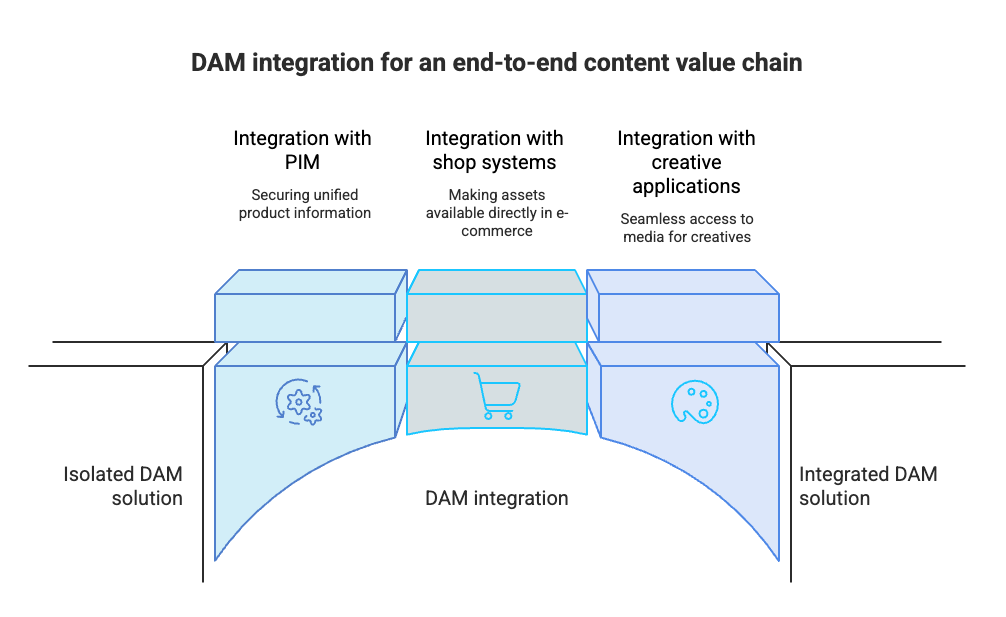
A digital asset management system delivers its greatest value not as a standalone software solution, but as the central component of an end-to-end content value chain. As content is created, enriched, approved, published and reused throughout its entire lifecycle, it continuously interacts with other enterprise systems. It is precisely at these touchpoints that integration capability determines whether processes are automated and efficient or slowed down by media discontinuities and manual tasks.
As the central platform for digital assets, a modern DAM connects creative teams, product management, marketing, e-commerce and external partners. At the same time, it ensures that images, videos, documents and other media are available exactly where they are needed. The more closely a DAM is integrated with the surrounding systems, the higher the data quality, process efficiency and reusability of content – and ultimately, the greater the business value of the entire content value chain.
Product Information Management (PIM)
PIM and DAM together form the foundation of professional product content management. While a product information management system manages all structured product information, such as technical data, attributes, descriptions and classifications, the DAM centrally manages all associated digital assets, including product images, videos, documents and marketing materials.
Only the integration of both systems creates a complete product context. Product data and digital assets are intelligently linked and made available to all downstream systems as a consistent source of information. This significantly reduces maintenance effort, prevents duplicate data storage and ensures that the correct content is always published together.
Sharedien already provides standardised integrations with leading PIM solutions such as Syndigo, myview systems and Viamedici. This enables organisations to seamlessly connect their product information and digital assets, making their product content processes considerably more efficient.
E-commerce platforms
The primary purpose of product content is to convince customers of a product’s value and support purchasing decisions. For this reason, e-commerce platforms and online shop systems are among the most important integration partners of a digital asset management system.
Through direct integration, approved images, videos and other media are automatically made available within the respective e-commerce platform. Manual exports, duplicate maintenance and time-consuming upload processes are eliminated. At the same time, organisations can ensure that only current and approved assets are published.
This significantly reduces time-to-market and enables organisations to make new products available online much more quickly. At the same time, customers benefit from consistent, high-quality product experiences across all digital sales channels – an important prerequisite for higher conversion rates and sustainable e-commerce growth.
Creative applications and external image libraries
Digital assets are not created within the DAM itself, but within an organisation’s creative processes. Designers, photographers and agencies work every day with applications such as Adobe Photoshop, Illustrator and InDesign, as well as with external image libraries and, increasingly, AI-based solutions for image generation and editing.
A modern DAM must therefore integrate seamlessly with these creative environments. Creative professionals can retrieve assets directly from their familiar working environment, edit them and save them back into the DAM without having to download files manually or store them multiple times. At the same time, metadata, versions and approval statuses can be synchronised automatically, ensuring full transparency regarding the current editing status at all times.
The integration of external image libraries and generative AI solutions is also becoming increasingly important. It enables organisations to create new content more quickly, reuse existing assets more efficiently and accelerate creative processes through targeted automation. As a result, the DAM becomes the central platform that connects all content sources and orchestrates the entire lifecycle of digital assets.
Business benefits of integration capability
The integration capability of a digital asset management system is far more than a technical feature. It has a decisive impact on how efficiently organisations manage their content processes and how much business value they can generate from their digital assets. The better a DAM is integrated into the existing system landscape, the more organisations benefit from automated workflows, higher data quality and much faster content delivery. The following advantages demonstrate why integration capability has become one of the most important selection criteria for a modern DAM system today.
- High potential for automation and AI: Artificial intelligence and automation deliver their greatest value not within individual applications, but across end-to-end business processes. Only when data and digital assets are available across systems can workflows be automated, content be intelligently enriched and repetitive tasks be reliably handled by AI. Integrating a DAM therefore creates the foundation for scalable automation and enables organisations to unlock the full potential of modern AI technologies across the entire content value chain.
- Shorter time-to-market: Every manual intermediate step costs time. When assets have to be exported, uploaded manually or transferred between different systems, the publication of new products and campaigns is significantly delayed. An integrated system landscape, by contrast, ensures that approved content is automatically transferred to the relevant target systems. As a result, organisations shorten their time-to-market, respond more quickly to market changes and gain a decisive competitive advantage, particularly in fast-moving industries.
- More efficient processes: Missing integrations often lead to duplicate data maintenance, manual coordination and unnecessary process steps. An integrated DAM significantly reduces these inefficiencies. Information is synchronised automatically, redundant tasks are eliminated and employees can focus on value-adding activities. At the same time, it creates the conditions for a higher level of automation and the targeted use of AI, enabling processes to become continuously more efficient while resources are used far more economically.
- Improved collaboration: Today, numerous internal and external stakeholders are involved in the creation and delivery of content – from creative teams and product management to marketing, e-commerce managers, agencies and photographers. By integrating the DAM with the relevant enterprise systems, everyone involved has access to the same up-to-date content and information. Coordination efforts are reduced, media discontinuities are avoided and collaboration across teams, locations and organisational boundaries becomes significantly easier and more transparent.
- Enhanced product experience: Images, videos, documents and other media are among the most important components of a compelling product experience. The faster high-quality content can be created, linked with product information and consistently delivered across all channels, the better the product experience for customers. An integrated content value chain ensures that digital assets are always current, complete and available in the right context, thereby creating the foundation for consistent product experiences across every touchpoint.
- Higher conversion: A better product experience has a direct impact on business success. High-quality, complete and consistent product content builds trust, simplifies purchasing decisions and reduces uncertainty throughout the buying process. At the same time, new or updated content reaches the market faster and becomes available to customers sooner. This results in higher conversion rates, increased online revenue and a sustainably higher return on investment from the entire content production process.
"Thanks to the central repository and AI-supported search, we can find the assets we need with Sharedien in no time – and thanks to Sharedien’s outstanding integration capabilities, the process of creating our international price lists has also become much more efficient."
Kai Storjohann, Head of Digital Marketing at wedi
Prerequisites for integration capability
Not every digital asset management system is equally suited to complex enterprise environments. While many solutions provide interfaces to other systems, true integration capability goes far beyond this. What matters is whether a DAM can be integrated flexibly into existing IT architectures, support a wide range of use cases and accommodate future requirements without difficulty. The following characteristics are key indicators of an integration-ready DAM system.
API-first
A modern DAM platform should consistently follow an API-first approach. This means that integrations are not added retrospectively through complex custom developments but are supported from the outset by an open and flexible software architecture. All system functions, business logic and data are made available through powerful APIs, allowing other applications to access them and retrieve content automatically at any time.
In modern enterprise architectures, content is no longer created in a single location – nor is it used exclusively by one system or one team. Digital assets are naturally essential for presenting products in online shops, marketplaces, mobile apps and product catalogues. However, customer service, product management and partner organisations also require access to image and video material.
Product data is maintained in the PIM, campaigns are published through the CMS, creative content is produced in design applications and marketing processes are managed in additional specialist solutions. An API-first DAM connects all these systems into a seamless content value chain, ensuring that digital assets are always available regardless of the specific use case.
Sharedien has been developed consistently according to this principle. Its API-first architecture enables rapid integration into existing enterprise landscapes while simultaneously providing the foundation for automation, AI applications and future expansion of the system landscape.
Focus on the data model
Alongside technical integration, it is above all the data model that determines how flexibly a DAM can support a wide range of business requirements. Digital assets are no longer just files – it is their relationships with products, campaigns, markets, brands, target groups and other objects that turn them into valuable business resources.
A flexible data model makes it possible to represent these relationships individually and tailor them precisely to an organisation’s requirements. Different asset types, metadata, relationships and structures can be modelled flexibly without rigid constraints limiting their use. This enables organisations to organise their content optimally according to output channel, business process or organisational structure and to reuse it efficiently.
Sharedien provides a highly flexible, relationship-based data model that can be adapted to a wide variety of use cases. This enables organisations to create the foundation for intelligent content structures, powerful search capabilities and AI-supported processes across the entire content value chain.
Partner network
Technical openness is reflected not only in a powerful architecture but also in a strong partner network. The more established standard interfaces and integrations are already available, the faster and more cost-effectively new systems can be connected.
A growing network of technology partnerships reduces implementation effort, minimises integration risks and enables organisations to expand their existing software landscape without costly custom development. At the same time, they benefit from proven integrations that are continuously enhanced and adapted to new requirements.
Sharedien continuously invests in expanding its technology ecosystem and already provides standard interfaces to numerous leading enterprise solutions. This enables organisations to make the best possible use of their existing IT landscape while gradually expanding their content value chain without fundamentally changing existing processes or systems.
Best practices for DAM integration
The technical connection of a digital asset management system is only one part of a successful integration. Organisations achieve the greatest value when they view the introduction of a DAM as a strategic transformation project and take a holistic approach to both processes and use cases. Those who align integrations with business processes create the foundation for a high-performing content value chain in which digital assets can be created, managed and used efficiently.
Sharedien can be implemented modularly and step by step. Rather than waiting for a complete big-bang rollout, measurable successes can be achieved with the very first integrated systems. This reduces project risks and quickly creates internal support for further scaling.
Use case analysis
Every DAM integration should begin by identifying where and how digital assets are actually used within the organisation. Which teams require which content? Which systems create, manage or consume assets? And which information needs to be available alongside those assets?
Only when these use cases are fully understood can data flows and integrations be planned effectively. The objective should be to make digital assets available exactly where they are needed – automatically, up to date and within the correct context. A consistent focus on real business use cases ensures that the integration not only functions technically but also delivers measurable business value.
Process analysis
Alongside technical interfaces, organisations should critically review their existing content processes. How are digital assets created? Which approval workflows are in place? Where do media discontinuities or manual tasks occur? And which teams collaborate along the content value chain?
Analysing these processes reveals opportunities for optimisation and prevents existing inefficiencies from simply being digitised. Instead, integrations should be used to simplify processes, increase transparency of responsibilities and sustainably improve the flow of information between teams and systems.
Automation and AI potential analysis (H3)
The greatest opportunities for automation and AI lie in recurring processes involving large volumes of data and numerous manual tasks. These include, for example, asset tagging, metadata enrichment, approval workflows and the distribution of content across different channels. Sharedien supports all major AI use cases within DAM directly at the system level.
"For us, it was essential that the new DAM system would reliably function as the central platform for all global Weidmüller locations and use cases. Sharedien now enables us to work more efficiently and optimise our internal processes. Another decisive factor was Sharedien’s integrated AI capabilities, which are already opening up new opportunities for automation and data quality."
Matthias Redecker, Head of Product Data Management at Weidmüller
Organisations should therefore analyse at an early stage where automation can generate the greatest business value. The prerequisite for this is seamless data flows and a closely integrated system landscape. Only when digital assets and the associated information are available across systems can AI applications unlock their full potential and sustainably accelerate the content value chain. Organisations that plan integrations from the outset with future automation and AI use cases in mind create a scalable foundation for long-term efficiency gains and competitive advantage.
Conclusion
The integration capability of a digital asset management system is now a fundamental prerequisite for successful content processes. Organisations that manage digital assets in isolation are missing out on valuable opportunities for automation, collaboration and growth. Only when a DAM is seamlessly connected to the relevant enterprise systems does it create an end-to-end content value chain in which information flows without interruption and digital assets can deliver their maximum business value.
When selecting a DAM system, integration capability should therefore be one of the most important decision criteria. A consistent API-first architecture, a flexible relationship-based data model and a strong partner network provide the foundation for connecting existing system landscapes efficiently while adapting flexibly to future requirements. At the same time, they enable the use of automation and AI throughout the entire content lifecycle – from asset creation to distribution across every channel.
Sharedien – The Driver of Your Content Value Chain – has been developed specifically to meet these requirements. As an API-first platform, Sharedien connects digital assets, product context and business processes within an intelligent content value chain. Through its flexible data model, powerful integrations and continuously expanding technology ecosystem, Sharedien enables organisations to automate their content processes, shorten their time-to-market and sustainably increase the long-term value of their digital assets.
Would you like to find out how Sharedien can be integrated into your existing system landscape and what opportunities this creates for your content value chain? Speak to our experts and discover how you can seamlessly connect your digital assets with your enterprise systems to generate measurable business value.
FAQs
What does integration capability mean in the context of digital asset management?
Integration capability refers to the ability of a digital asset management system to communicate seamlessly with other enterprise applications and exchange data. These include PIM, CMS and e-commerce systems, as well as creative applications, marketing solutions and ERP systems. The goal is to make digital assets automatically available wherever they are needed and to enable end-to-end workflows across the entire content value chain.
What business benefits does DAM integration capability provide?
An integration-ready DAM accelerates content delivery, reduces manual tasks and improves collaboration between teams and systems. At the same time, it creates the foundation for automation and the use of AI, making processes more efficient and scalable. Organisations benefit from shorter time-to-market, greater asset reuse, an improved product experience, higher conversion rates and increased online revenue.
How can I recognise whether a DAM system has strong integration capabilities?
The key characteristics include an API-first architecture, a flexible data model and an extensive network of standard interfaces and technology partners. Modern DAM systems can therefore be integrated into existing enterprise environments without complex custom development and can be adapted flexibly to future business requirements.
Why is integration capability important in DAM?
Digital assets only create real business value when they are available to the right people and systems at the right time. Without integration, data silos, media discontinuities and manual processes arise, wasting time and causing errors. An integration-ready DAM, by contrast, connects all relevant systems into an end-to-end content value chain. This enables organisations to automate their content processes, improve data quality, respond more quickly to changing market demands and sustainably increase the business value of their digital assets.
Which systems should a digital asset management system be able to integrate with?
A modern digital asset management system should integrate seamlessly into the existing enterprise landscape. This includes product information management (PIM), content management systems (CMS), e-commerce and online shop platforms, ERP and CRM solutions, as well as creative applications such as Adobe Photoshop, Illustrator and InDesign. Marketing automation platforms, external image libraries and AI solutions are also becoming increasingly important. The better a DAM connects these systems, the more efficiently digital assets can be created, managed, distributed and reused throughout the entire content value chain.
Why is an API-first architecture so important for a DAM?
An API-first architecture ensures that a digital asset management system has been designed from the ground up for integration with other systems. Rather than adding interfaces retrospectively to a closed system, all functions and data are made available from the outset through standardised APIs, allowing new systems to be connected quickly and processes to be automated flexibly. This makes it easier to integrate new applications, automate existing processes and adapt to future requirements. At the same time, an API-first approach provides the technical foundation for seamless data flows, intelligent automation and the use of AI across the entire content value chain.
About the author
The Sharedien product team provides insights into the latest trends, innovations, releases and best practices.

More
articles
Keep reading and take a look at our latest blog articles.
.png)


Basel, Switzerland: An Evening Without Slides or Pitches